
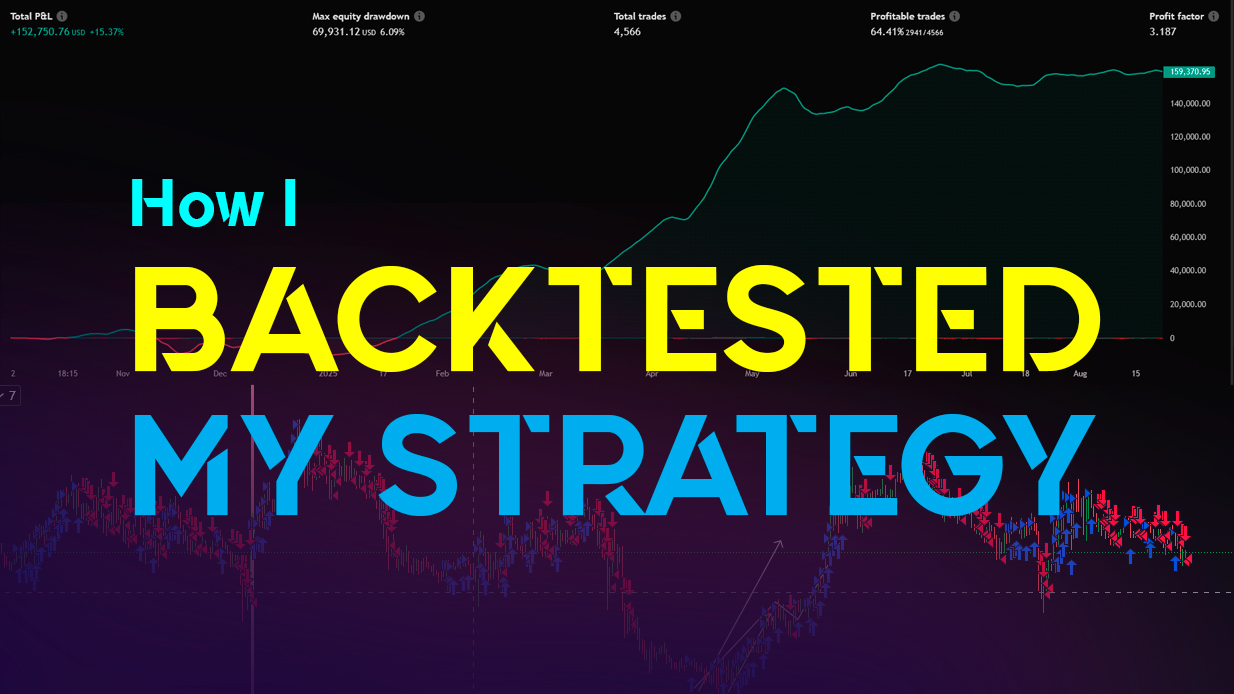
How I Backtested My Strategy (And What Actually Made It Work)#
Building a Strategy Is One Thing — Trusting It Is Another#
Like many traders, I started out doing what felt logical: I built a strategy on TradingView, added some indicators, and threw it into a backtesting tool to see how it would perform.
At first glance, it looked promising. Solid win rates. Clean entries. High returns.
But deep down, I wasn’t convinced. There was a voice in the back of my mind saying: “Sure, it worked on past data — but will it work when I actually run it?”
That’s when I realized that backtesting alone doesn’t equal confidence. You can’t just look at a result and trust it. You need to feel the trades. See how they play out. Know how the system behaves when the market gets weird.
So I kept testing. And more importantly — I changed how I tested.
Backtesting Tools Were Not Enough#
I started with common backtesting services. The kind where you plug in your logic, pick a timeframe, hit run, and get a report. It’s fast. It’s efficient. But it also hides the details that matter.
You don’t see the actual setups as they form. You don’t feel the hesitation when price hovers around your entry. You don’t see if the stop loss would realistically hold — or if it would get wicked out. You just get an output.
Then I moved to TradingView, using its built-in strategy tester. It gave me more visual feedback, and I could test on different instruments with ease. I’d tweak variables, run different timeframes, and optimize for profit factors.
But something still felt off. It was mechanical. Detached.
It wasn’t until I started using Replay Mode and Paper Trading that things changed.
I began manually running through charts, candle by candle, watching how my strategy behaved in real time — but with historical data. I wasn’t just reviewing numbers. I was watching the story of the market unfold, using my strategy as the lens.
I also paper-traded live, letting my system send alerts or signals, and logging each result manually — even if I wasn’t executing with real money.
Suddenly, I saw where entries were too aggressive. Where false signals appeared. Where my setup worked beautifully — and where it needed adjustments.
This wasn’t just testing anymore. It was refining. It was real.
What Actually Gave Me Confidence#
Once I combined structured backtesting, manual replay testing, and real-time paper execution, things started to click.
I stopped chasing new systems. I stopped doubting every trade. I started trusting the logic — because I had watched it succeed and fail, over and over, with full transparency.
The strategy I run now? It’s the same one I backtested at the beginning — but it’s gone through a dozen small tweaks that only showed up during replay and paper sessions. And those tweaks made all the difference.
That’s the part most traders skip. They want the shortcut, the numbers, the signals. But strategy confidence doesn’t come from a percentage on a backtest report. It comes from experience. Even simulated ones.
Final Thoughts#
If you’re serious about building a strategy that lasts, don’t stop at the backtest report.
Run it through replay mode. Watch it unfold. Paper trade it on live charts.
Feel how it performs when markets slow down, speed up, fake out, and break down.
That’s where the real edge is — not in code or indicators, but in the experience of seeing your system prove itself.
When you do that, you don’t just trade better. You trade calmer.
Because you’re not guessing anymore. You know how your strategy behaves — and that makes all the difference.